'change or stay home' !

By Adrian Wojnarowski, Yahoo! Sports Jul 16, 4:17 pm EDT
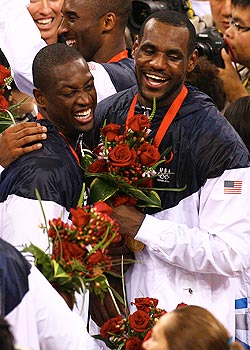
And yet before Pat Riley’s free-agency vision for the Miami Heat could ever be validated, James had to first become a member of that 2008 Olympic team. The public never knew what those on the inside of American basketball’s elite power structure did: In the years and months before Beijing, that was very much in doubt for James.
(Getty Images)
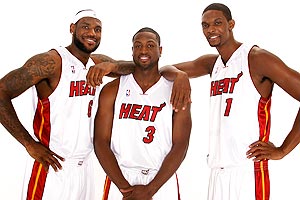
Back when the Heat’s three new superstars had signed short contract extensions and started to explore the idea of free agency thrusting them together, a different discussion had played out within the NBA and USA Basketball: What should we do with LeBron?
From Team USA coach Mike Krzyzewski to managing director Jerry Colangelo to NBA elders, the issue of James’ immaturity and downright disrespectfulness had become a consuming topic on the march to the Olympics. The course of history could’ve changed dramatically, because there was a real risk that James wouldn’t be brought to Beijing based on fears his monumental talents weren’t worth the daily grind of dealing with him.
When the mandate had been to gather these immense egos and get the NBA’s greatest players to fit into a program, no one had a more difficult time meshing into the framework than James. Other players made it a point to learn the names of staffers and modestly go about their business without barking orders and brash demands.
No one could stand James as a 19-year-old in the 2004 Athens Olympics, nor the 2006 World Championships. Officials feared James could become the instigator of everything they wanted to rid themselves for the ’08 Olympics. For as gifted as James was, Krzyzewski and Colangelo subscribed to a belief that with Kobe Bryant(notes) joining the national team in 2007, they could win a gold medal in ’08 with or without LeBron James. Behind the scenes, officials had taken to calling James’ inner circle, “The Enablers.” No one ever told him to grow up. No one ever challenged him. And yet, James was still a powerful pull for his teammates, and everyone had to agree they could no longer let his bossy and belittling act go unchecked. These weren’t the Cleveland Cavaliers, and Team USA wasn’t beholden to him.
After the NBA witnessed the behavior of James and his business manager Maverick Carter during the 2007 All-Star Weekend, the commissioner’s office sent word to USA Basketball the league wouldn’t force James on them for the Olympics. Before Team USA gathered for the 2007 Tournament of the Americas in Las Vegas, an unmistakable message had been delivered to James through Nike: Unless you change, we’re serious about leaving you home.
“Legacies were on the line,” one league official said, “and they weren’t going to let LeBron [expletive] it up for everyone in China.”
Through Nike, James ultimately heeded the message and became more tolerable to coaches, teammates and staff. Team USA assigned Jason Kidd(notes) to babysit him at the Tournament of the Americas in 2007, to try to teach him something the Cavaliers never had a veteran to do: professionalism.
When James returned to the Cavaliers, the franchise hoped that he had grown, matured and maybe learned some lessons. Only James understood the angles and leverage he had in Cleveland. Every day, owner Dan Gilbert and general manager Danny Ferry wondered: What must we do to get him to re-sign in 2010?
What will make him happy?
The answer, as the Cavaliers eventually discovered, was nothing. James lived to make demands, but those with knowledge of his plans insist he never intended to re-sign with the Cavaliers.
One week after James joined Wade and Bosh in Miami to potentially alter the NBA’s balance of power for years, Yahoo! Sports has shaped a story of how events unfolded in the free-agent frenzy of 2010 based on interviews with several sources who were either involved in or have direct knowledge of the process.
Within an hour of the Cavaliers’ season ending in Boston, James’ inner circle, including power broker William Wesley, agent Leon Rose and business manager Maverick Carter, stood outside the visiting locker room grumbling about coach Mike Brown.
James had wanted Brown gone a year earlier after the Cavs lost in the Eastern Conference finals to the Orlando Magic – despite Brown guiding Cleveland to 66 victories while winning the league’s Coach of the Year award. Ferry debated Gilbert to keep Brown. He won out, but Ferry knew it would be tough to make that case again in 2010. Every decision the Cavaliers made had to be run past James. He didn’t always get to decide, but he had to be consulted.
(Getty Images)
This time, Gilbert believed he had to fire Brown to have a chance of re-signing James. When he was fired, Brown purposely left his star’s name out of a public statement of thanks. He knew James had led the movement for his dismissal for more than two years and Brown no longer needed to pretend that he liked, or respected James.
Ferry warned the owner there wouldn’t be a better coach available to hire. Eventually, Gilbert pushed out Ferry, too. The owner wanted to take over a bigger portion of the basketball decision-making and Ferry’s stubbornness made that difficult for him.
The franchise was in complete upheaval, and Gilbert had the Cavaliers trying everything possible to impress a non-responsive James. The Cavaliers star had started to fully distance himself from the organization. He refused to get on the phone and discuss his future with Michigan State’s Tom Izzo, whom Gilbert had offered $30 million to take over as coach.
Before the Cavaliers ever reached out to him, Izzo turned down a less lucrative offer to coach the Chicago Bulls. James wasn’t returning Gilbert’s calls and messages – never mind willing to talk with Izzo. Before Izzo finally turned down Gilbert, he was delivered a direct line to two of James’ close NBA friends, who told him he should only take the job with an expectation he’ll never coach James in Cleveland. Gilbert tried to sell Izzo, but the coach feared there wasn’t a single influential official in the Cavs organization who truly had a relationship with James.
No one had more intelligence and better monitored the disconnect between James and the Cavaliers than Miami Heat president Pat Riley. He had informants and spies everywhere, including his own star, Wade, who had been telling Riley for most of two years they could lure James to South Beach. The Heat had everything they needed to sell James, except for what finally arrived on the eve of the NBA draft: salary-cap space.
On the night before the draft, Riley hung up on a call with Oklahoma City Thunder GM Sam Presti to complete a salary dump of Daequan Cook(notes). It wouldn’t be long until word traveled to everyone. LeBron James. Dwyane Wade. Chris Bosh. The Heat had the salary-cap space to make this happen. All these months of planning, all these contingencies, and now the greatest free-agent coup in history was within reach.
When the NBA powerbroker and adviser to James, William Wesley – famously known as Worldwide Wes – heard the news, he was duly impressed. After all these months, all this careful planning, Riley had cleared the cap space to give the three stars of free agency contracts starting at about $15 million.
For months, Wesley had believed James’ choice would be the Chicago Bulls, but no one had counted on Riley’s relentlessness in clearing enough cap space to accommodate the three stars. Free agency wouldn’t officially start for another week on July 1, but from then on, Wesley had two words about LeBron and the Heat for the closest of associates: done deal.
Worldwide Wes had understood something about James the Cavaliers refused to believe, and even James’ childhood buddies from Akron were still somewhat unwilling to accept: LeBron James was never re-signing with the Cleveland Cavaliers, and now it was a matter of securing him the proper complement of teammates for the greatest free-agent haul in history.
Riley was 65, a five-time NBA champion, a Hall of Famer and he wanted a dynasty to fade into the sunset of his basketball life. He had kept his word, continuing to dump contract upon contract in a high-wire act that left him without a safety net.
Riley believed he could unload those contracts. And mostly, he believed in his own power of persuasion. He is still the biggest presence, biggest voice in the room. Houston Rockets GM Daryl Morey, a statistics analyst, met with Chris Bosh at 12:01 a.m. on July 1 armed with an iPad. Morey’s cult followers on the web hailed it as a resounding success, but Riley never believed he was losing Bosh to the MIT gang.
Riley believed in his ability to get into the room with James and sell him on the way the 1980s Los Angeles Lakers sacrificed salary, shots and statistics for the greater good of a dynasty. Most of all, Riley believed he could benefit on the close relationship that James had with Wade, and that there wasn’t a franchise with cap space that could offer such a compelling case to the two-time defending MVP.
Riley ran the Heat franchise in a bold way. He had two things to sell the best players in the NBA: South Beach and his bigger-than-life persona. The Heat don’t bother scouting internationally. They didn’t believe much in the college draft. They constantly planned around free agents and trades, a high-risk, high-reward way to steer an organization.
(Getty Images)
All along, teams believed Bosh would choose to play with James or Wade. What Bosh truly wanted was to play with James and Wade. It was commonly accepted that Bosh’s time with the Toronto Raptors taught him he couldn’t be the centerpiece player, and so he embraced the idea of playing the part of Robin to James’ and Wade’s Batman.
Wade had come to believe James would likely leave Cleveland, but became largely certain once the Cavaliers lost to the Boston Celtics in the Eastern Conference semifinals. For the first time, James could no longer blame his supporting cast and coaching for a playoff exit. His peculiar performance in a Game 5 blowout, lethargic and distant, pushed James on trial.
Within days of the season’s end, James and Carter traveled to Winston-Salem, N.C., for the birthday party of New Orleans Hornets star Chris Paul’s(notes) young son. With James on the premises, rules for the toddler’s birthday party included no photos, no video.
James was close with Paul, and free agency and the possible connecting of the players’ futures did come up in conversation. Paul was unhappy with the Hornets, and frustrated to see so many of his Team USA teammates on championship contenders and playoff teams. James and Carter long had been trying to recruit Paul to their LRMR marketing company and the Rose/Wesley/CAA cluster for his contract representation.
As a prelude to Paul eventually going into business with James, Wesley began working the New York Knicks and New Jersey Nets to get them to try and trade for Paul with the strong suggestion that it could deliver James in free agency. Both tried, both failed.
As Wesley worked front offices, his stature started to rise out of the subculture of the sport and into mainstream news coverage. Carter wanted credibility beyond the public perception of him as merely James’ childhood buddy, and ultimately he could no longer hide his jealousy when Wesley started to get too much public recognition for packaging the players in free agency. Privately, everyone in the circle knew James was leaving Cleveland, and it would be harder for his Akron guys to get credit for the deal.
During the NBA Finals, Carter met entertainment mogul David Geffen at a party in Los Angeles. Carter talked informally with Geffen’s people about the possibility of them attempting to purchase a majority share of the Los Angeles Clippers and signing James with the team’s cap space. Carter even made sure to show up with Geffen courtside at Staples Center for a game in the Finals to elevate his stature as a major mover, but buzz died fast when Clippers owner Donald Sterling made clear he had no interest in selling his team.
After a Yahoo! Sports column detailing the strife within Team LeBron in late June, Carter unwrapped his jealousy and called the New York Times to insist Wesley would have nothing to do with choosing a team. Wesley had unsuccessfully shopped Kentucky coach John Calipari to the Chicago Bulls as a preferred coaching candidate for James, but the Bulls made a run for Izzo and ultimately settled on a less-expensive client of CAA, Celtics assistant coach Tom Thibodeau.
Wesley wanted the commission on Calipari’s pro contract, but no one wanted to hire him. James did have a strong bond with Calipari, but ultimately he was much more interested with the ownership, front office and talent on the floor. James understood that coaches were easily disposable, but the rest had more staying power.
Nevertheless, Wesley reacted with caution over Carter’s public proclamation to back off, and slid further into the background. Still, he stayed in close contact with James through a Nike official, Lynn Merritt, and let Carter cool down from his public tantrum. Carter worried far more about Wesley than Wesley did about Carter. There were such doubts about the kinds of advice that Carter had been giving James, about the staying power of that bond, that Wesley was willing to play it out and see who would still be standing beside LeBron James.
The New Jersey Nets – with owner Mikhail Prokhorov and minority partner Jay-Z – were the first team to make a formal presentation to James at the offices of his LRMR marketing company in downtown Cleveland on July 1. This was the meeting that most intrigued James, because he had never been in the room with Prokhorov, the Russian billionaire and new Nets owner. This was a self-made global tycoon, different than the rest of the owners, and this surely intrigued James.
Prokhorov was long, trim and athletic, and at 6-foot-9 inches able to look James in the eyes when greeting him for the first time. The Nets made a pointed, flashy presentation on the franchise’s eventual move to a new arena in Brooklyn and delivered a creative, if not embellished, explanation of how Prokhorov held a international blueprint for James on how to catapult him someday into the billionaire athlete that he always wanted to be.
For James, the problem with back-to-back presentations was his short attention span. Cavaliers coaches had always tried to keep film sessions short because James would drift away and lose interest. As the New York Knicks followed the Nets by repeating those themes with an array of power points and charts about accumulating wealth, James drifted in and out of focus. Later, James would tell Jay-Z that parts of New York’s presentation felt too redundant to New Jersey’s.
In this free-agent push for James, the Nets were something of a wild card, largely because of his close relationship with Jay-Z. In so many ways, James wanted to emulate the music mogul’s platform. In pitching the Nets, who had won only 12 games, Jay-Z kept reminding LeBron that he cared too much about his own brand to ever associate it with something unworthy. The Nets were going to be a force, he promised. With a partnership together, they could own New York and someday the sporting world.
At the start of free agency, the Nets erected a 127-foot billboard of Prokhorov and Jay-Z across from Madison Square Garden. Knicks owner James Dolan was irate, called Jay-Z and told him the mural intimidated his employees.
As it started to get back to Jay-Z that the Nets were trailing to the Heat and Bulls, a Nets official close to ownership – against the wishes of several peers – hatched a plan to leak the notes of a Prokhorov staff meeting to a media outlet. The leaked notes indicated that Prokhorov believed James’ brand would be diminished as part of a three-star team in Miami. What’s more, the notes also indicated what great respect Prokhorov had for Maverick Carter.
The Bulls still believed they were strongly in the bidding for James. They met him on July 2, and for all the discussion later about the belief that Chicago wouldn’t give jobs and access to members of James’ inner circle, the issue had never been raised with team executives.
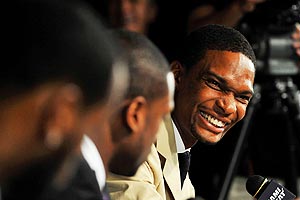
(Getty Images)
For everything the Bulls tried to sell – from owner Jerry Reinsdorf to GM Gar Forman to coach Tom Thibodeau – there had been one thing that troubled James’ about the Bulls pitch: Derrick Rose(notes) never called and tried to recruit him.
Chicago officials never directly requested Rose to reach out with a call, and the young point guard felt James could’ve always reached out to him had he wanted to discuss the possibility of playing together. James needed to be courted, needed to be wooed and apparently it surprised him there was a star who wasn’t falling over himself to do that.
On the eve of the Bulls’ meeting with James, Forman and vice president John Paxson requested and received a second visit with Wade within 24 hours in Chicago. They met for a couple hours in the office of Wade’s agent, Henry Thomas. Chicago believed it needed badly to emerge out of the meeting with a commitment from Wade to take to James in Cleveland. The Bulls could still make a couple of moves to position them further under the cap and sign two maximum salary players.
Without James committed to joining him in Miami, Wade hadn’t completely let go of the Bulls as a bargaining chip. He knew Bosh would come with him, but LeBron still hadn’t told him that he was going to sign with Miami.
Nevertheless, Riley’s presentation on July 3 pushed James closer to committing than ever. Riley never did pitch James on his own return to coaching, and yet bringing those five championship rings into the meeting were his way of selling James on the fact that Riles’ prints would be all over the team. No other basketball executive in the process could tell James they understood what a title team needed, what it looked like and how they had already done it like Riley could. Riley had such credibility, such presence and he completely captivated James.
Want the best talent? It’s here. Want a Hall of Fame coach? He’s upstairs, waiting for your arrival. Nevertheless, Riley had backed far away from a news conference at season’s end when he suggested he would be willing to return to the bench should a free agent deem it a deal-breaker to sign with the Heat. For James, it wasn’t. Wade had sold him on Erik Spoelstra, and Wade didn’t want Riley hovering over this coach the way he had Stan Van Gundy before taking over on the title run in 2006.
Perhaps Riley could always be seduced to the bench, but he has privately told people he has come to cherish his ability to escape to his Malibu home for a few days here and there in the season. In a lot of ways, the grind no longer appeals to him and he’s wanted to give Spoelstra, his longtime apprentice and understudy, every chance to succeed.
Nevertheless, the pressure on Spoelstra to win a championship in 2011 promises to be immense. To keep his job, he’ll probably have to win it all, especially because Riley has his eye on Doc Rivers to someday coach the Heat. Rivers has one year left on his Celtics contract, and has been heavily affected by the distance between him and his family still living Orlando.
Riley never sold any coach to James in the meeting, but the one sitting next to him. Yet, James understood that Riley ultimately had no loyalty to anything but winning.
Wade wasn’t allowed to recruit for the Heat before the end of the NBA Finals, because he was still a Heat employee. Yet before the end of the Finals, there were two June meetings that involved Wade and members of James’ inner circle – one in Ohio and another in Chicago. The NBA doesn’t seem interested in pursuing a tampering probe, but a senior NBA official wants the league to investigate whether Riley promised James employment and benefits to members of his camp.
“The bigger issue is salary-cap circumvention,” one top NBA front-office executive told Yahoo!. “You can’t promise jobs or preferential services outside of a contract or a job for a friend. If that’s part of the deal, it’s a violation.”
(Getty Images)
The way James lost to Boston in the Eastern Conference semifinals turned out to be a boon to the Heat. The pressure was on James to start winning titles and Riley understood this was playing into his favor. The criticism of failing to win a title weighed on James, and Wade worked him over on it. All that would fade away with the Heat, and it wouldn’t be a matter of winning a single title but rather how many they would line up.
James, Wade and Bosh talked on the telephone late on July 6. Wade had gone back to Miami and met with Riley and Heat owner, Micky Arison, and was ready to formally commit to staying. He had Bosh in his pocket, and now they just needed James to make the move with them. They hung up the phone late that night and thought James was prepared to make the jump with them.
Wade and Bosh made public their choices on July 7 and waited for word that would soon quietly come to them: LeBron was on his way to Miami, the greatest coup in free-agent history complete. Later that day, Carter was on the phone with free agent Mike Miller(notes) telling him that James was going to Miami and that he needed to join them as a sharpshooter playing off the three stars.
Back in Akron, James still wanted to go through his live hourlong television show on July 8 to announce his decision. This had been Maverick Carter’s big idea, his production, and still people around him worried about the fallout in Cleveland. Several friends told James this was a bad idea to do to his hometown, that leaving the Cavaliers live on national television would make this a public-relations disaster for him.
James didn’t seem to agree, didn’t think it made a difference. Mad was mad, he thought. He would take a beating, but it would subside and people would love him again in Cleveland. The TV event had delivered hope to the Cavaliers that they would keep James because they never believed he would go on air and open himself to such a visceral reaction.
Better than anyone, they knew LeBron James could sometimes be so unaware of the world outside his own needs, his own yes men. Nearly two years later, the whispers in the back of the bus rolling through Beijing had become the loudest statement in free-agency history. The telephone call to the Cleveland Cavaliers came minutes before the 9 p.m. show, and somehow the news still shocked them. LeBron James was leaving, and the truth finally washed over owner Dan Gilbert and his front office: James had been gone a long time. They just never wanted to believe it.